GALLUP NEWS SERVICE
PRINCETON, NJ -- As most Americans celebrate Christmas this year, they have a much more skeptical view about the influence of religion on American life than they did a year ago in the aftermath of the Sept. 11 terrorist attacks, but a view that remains slightly more positive than it was for much of the decade of the 1990s. According to a CNN/USA Today/Gallup poll, conducted Dec. 9-10, 51% believe that religion as a whole is losing its influence on American life, while just 43% say its influence is increasing. A Gallup poll a year ago found a record 71% of Americans saying religion's influence was increasing, while just 24% said it was declining.
| Is Religion Increasing Or Losing Its Influence on American Life? |
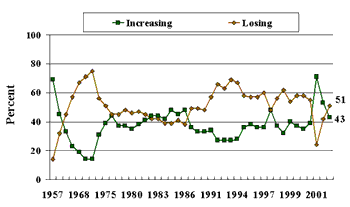 |
When Gallup first asked the question in March 1957, 69% of Americans saw an increasing influence, but five years later the percentage had declined to 45%, and by the end of the decade it was at 14%. By the mid-1980s, the percentage reached as high as 48%, but then declined as low as 27% in the early 1990s. In January 1998, it reached 48% again, but until the terrorist attacks in the fall of 2001, a majority of Americans continued to say that religion was losing rather than increasing its influence. The 71% who said religion was increasing its influence a year ago were no doubt reflecting the rally effect that occurred in the wake of 9/11. By March of this year, the rally effect was waning; with 53% saying religion's influence was increasing. The current results are fairly close to the last pre-9/11 poll, Feb. 2001, when a majority also said religion was losing its influence (by 55% to 39%).
Who Is Most Likely to Say Religion Is Losing Its Influence?
The poll shows that there are major differences in people's view about the influence of religion among men and women, different age groups, and regions of the country.
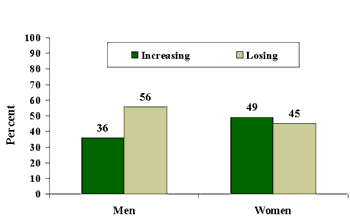
Compared with women, men are much more likely to say religion is losing its influence. While women are about evenly divided on the question, a clear majority of men take the more skeptical view.
| Is Religion Increasing Or Losing Its Influence on American Life? By Gender |
 |
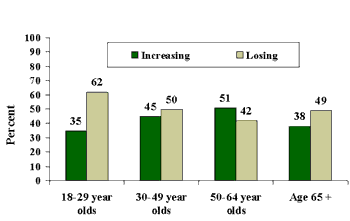
The youngest group of Americans, under 30, are the most skeptical about the influence of religion, with a clear majority (by 62% to 35%) saying religion is losing influence. By contrast, people in the pre-retirement years, 50-64, are the most likely to think religion is increasing its influence, with a slight majority taking that view (by 51% to 42%).
| Is Religion Increasing Or Losing Its Influence on American Life? By Age |
 |
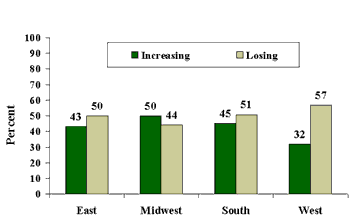
Americans' views on this issue also vary substantially by region of the country, with residents of the Western U.S. most skeptical (by 57% to 32%, they say religion is losing its influence) and Midwesterners least so (by 50% to 44%, they say religion is increasing its influence).
| Is Religion Increasing Or Losing Its Influence on American Life? By Region |
 |
Little Change in Actual Behavior or Beliefs Since Dec. 2001
Despite the general skepticism about the continuing influence of religion, the current poll shows that Americans' religious behavior and beliefs have hardly changed from what was reported in a Gallup poll a year ago, in December 2001.
- Today, 61% of Americans say religion is "very" important in their own lives, compared with 60% who said that in Dec. 2001.
- 66% of Americans today say they belong to a church or synagogue, identical to what was reported last year.
- The current poll finds 43% of Americans saying they attended church or synagogue in the past week, virtually the same as the 41% measured last year.
- This year as well as last, 45% of Americans say they generally attend church or synagogue weekly or almost weekly.
- Just under half of all Americans (46%) say they describe themselves as "born-again or evangelical," slightly higher than last year (42%).
- This year, 59% of Americans say that religion can answer most or all of today's problems, while 24% say religion is largely old-fashioned and out of date. Last year, the percentages were very similar: 61% vs. 21% respectively.
Survey Methods
The latest results are based on telephone interviews with 1,009 national adults, aged 18+, conducted December 9-10, 2002. For results based on the total sample of National Adults, one can say with 95% confidence that the margin of sampling error is ±3 percentage points. In addition to sampling error, question wording and practical difficulties in conducting surveys can introduce error or bias into the findings of public opinion polls.
