Was the generation gap invented the first time a young person swallowed a goldfish or watched Elvis Presley on the Ed Sullivan Show? Or when music videos replaced the radio? Not a chance. Long before tattoos, shaved heads, or even blue suede shoes, generations have collided on all sorts of issues -- political, moral, and otherwise.
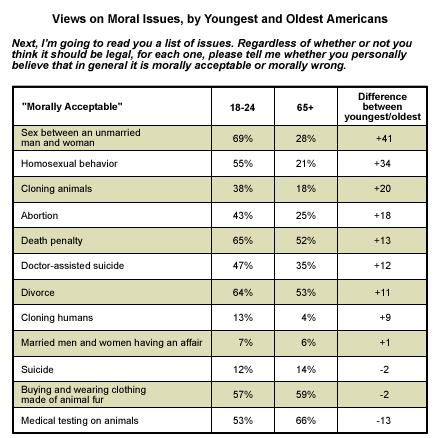
Every year, Gallup's Moral Views and Values survey asks Americans whether certain issues are morally acceptable or morally wrong. Aggregated data from the past three years* show that generational differences of opinion are sharp on some issues and virtually absent on others.
Americans of various age groups are all in relative agreement on the moral acceptability of issues such as: buying and wearing clothing made of animal fur, suicide, and men and women having an extramarital affair.

On some issues, however, members of different age groups are more likely to disagree. One striking example concerns the perceived morality of "homosexual behavior." Fifty-five percent of the youngest adults (aged 18 to 24) think homosexual behavior is morally acceptable, compared with 45% of 25- to 44-year-olds, 41% of 45- to 64-year-olds, and only 21% of those 65 and older.
Attitudes about medical testing on animals, on the other hand, are skewed in the opposite direction. Only a slight majority, 53%, of the youngest Americans feel that such testing is morally acceptable, but older respondents are much more accepting of it -- 65% of 25- to 44-year-olds think it's OK, as do 64% of 45- to 64-year-olds, and 66% of those aged 65 and older.
Widest Gaps Between the Young and the Old
Among the 12 moral issues tested in each of the last three years, there are six that those aged 65 and older find significantly less acceptable than all other age groups do: the death penalty, divorce, sex between unmarried men and women, doctor-assisted suicide, homosexual behavior, and abortion.
Not surprisingly, the greatest gulfs lie between the youngest and oldest Americans. The most significant difference between these generations shows up in attitudes regarding sex -- about 7 in 10 18- to 24-year-olds (69%) believe that sex outside of marriage is morally acceptable, while just 28% of those aged 65 and older share this view.
"The attitudes of the young will change somewhat as they grow older," observes Lovett Weems Jr., a lifelong teacher and former president at Saint Paul School of Theology in Kansas City, Mo. "However, the patterns will probably not change considerably. What we are seeing here is a cultural shift on several issues of sexuality and morality very much like what happened in previous years as the population as a whole shifted in its moral perceptions about divorce."
Jessie Ott, an 18-year-old college freshman from Ann Arbor, Mich., agrees with her peers that unmarried sex and homosexuality are morally acceptable. She suspects that her grandparents feel very differently on those issues and, to maintain family harmony, avoids discussing moral questions with them. "The social norms are very different now from what they were in my grandparents' time," Ott said, "Back then, holding hands in public was a big deal. But times have changed and we have new traditions now."
Bottom Line
Divergent attitudes among age groups are an inevitable side effect of social change. Weems sees educational opportunities in these differences. "Each can learn a great deal from the other. The young help older persons question and clarify moral practices and positions taken for granted for lifetimes. Older persons, as illustrated in the lower support among the older group for the death penalty, can offer the young a perspective gained from age that moral issues that may seem simple are often much more complex."
Regina Ovesey, a retired New York advertising executive in her 70s, is one example of an older American who aligns solidly with the younger generations on most moral issues. "In my generation, people had to get married in order to have sex," she said. "Hopefully, now people have the chance to avoid the entanglements of marriage and children until they see if the relationship is working out. Older people should learn to accept change -- unless that change is destructive to individuals."
*Results based on an aggregate of telephone interviews with 3,028 American adults, aged 18 and older, taken from polls conducted each May from 2001 through 2003. For results based on the total sample, one can say with 95% confidence that the maximum margin of sampling error is ±2 percentage points.
For the sample of 285 18- to 24-year-olds, the maximum margin of sampling error is ±6 percentage points.
For the sample of 733 25- to 38-year-olds, the maximum margin of sampling error is ±4 percentage points.
For the sample of 1,983 Americans 39 and older, the maximum margin of sampling error is ±2 percentage points.