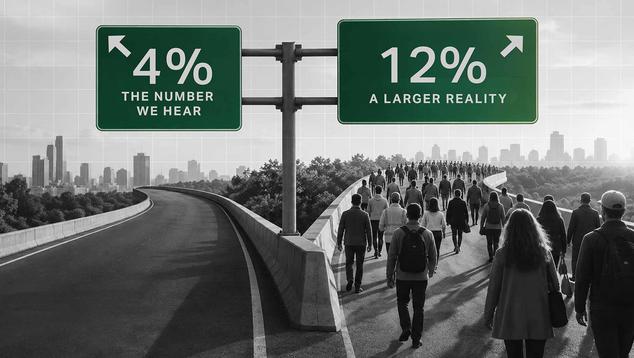
According to Gallup, citizens and leaders believe we are living through a crisis in democracy.
A crisis in political division. A crisis of trust in nearly every institution. Even a crisis of hopelessness and a growing epidemic of loneliness.
Underneath these crises, making them worse every year, is a national misunderstanding about jobs and unemployment in America.
I once called it “The Big Lie.” But as it persists, I believe it is more of a national misunderstanding.
Here it is.
The monthly reported unemployment numbers are not what we think they are.
The roughly 4% unemployment rate measures something very different from what people often hear in the mainstream media or from well-meaning thought leaders: “all-time low,” “full employment” and similar descriptions.
They are mistaken.
The government also reports a measure called U-6. It includes the unemployed people, those “marginally attached” to the labor force and people working part time who want full-time work. The U-6 measure raises the 4% to about 8%.
That gets us much closer to the truth and pain on the ground.
Yet much of the national narrative, including commentary from leading economists on the left and the right who seem to understand all of this, continues to describe unemployment as about 4% and the country as being at full employment.
This is extremely misleading.
I recently read a Wall Street Journal op-ed written by a well-known and highly respected American investor who cited U.S. unemployment at 4% and called it “full employment by any definition.”
“Consider what the machine was pricing. Inflation is 3% to 4% and has been above the Fed’s target since 2021. Unemployment is 4.1%, full employment by any definition.” —American investor
Again, I don’t believe anyone is intentionally attempting to mislead us.
The monthly number today of about 4% represents roughly 6.5 million Americans who are unemployed, looking for work and not working.
When including prime working-age (25-54) men and women "not working," what I call real unemployment is closer to 12%. About 22 million out of work.
Mars away from full employment.
Very few American leaders know how unemployment in America is calculated. Test yourself. Did you know the number comes from a government-run poll rather than a census or a count based on IRS receipts?
The regularly reported unemployment rate comes from a monthly government survey of roughly 60,000 households. The Census Bureau conducts the survey for the Bureau of Labor Statistics (BLS). It is very good data. Nothing is “deep state” about it.
The U.S. has roughly 135 million full-time workers. Not all of them have great jobs, but they work full time — 35 or more hours a week with a paycheck — for an employer.
The BLS tells us that 6.5 million Americans are unemployed. Roughly 400,000 more have stopped looking for work and are not counted as unemployed but classified as discouraged. About 4.4 million work part time but want full-time work — they’re technically classified as underemployed.
Here is where the plot thickens.
An additional 6.5 million prime working-age men are at home not working. An estimated 4 million prime working-age women are also at home not working. (These figures exclude men and women who are raising children or caretaking.)
That puts a minimum of 10 million prime working-age citizens outside the labor force.
Do you wonder what they are doing?
Call me crazy, but these 10 million look pretty unemployed to me.
My own research finds that the majority of those at home not working would love to have a good job — one that fits their education, training, strengths and interests.
Gallup has consistently found that humans want work that allows them to contribute to something they consider meaningful. They want to be a part of building something they deem worthwhile. Dignity, self-worth and even how people feel about their country and how they vote are tied to all of this.
Through our U.S. and World Polls, Gallup discovered what we call the will of the world. The will of the world is to have a good job. Period. All the other good stuff, like marriage, family, home ownership and serving others, comes next.
The Great American Dream rides on a good job.
American thought leaders and tech titans are now predicting that the U.S. and the world are likely to experience unimaginable job loss as AI displaces human jobs. An event like that would raise people’s interest in socialism and things like universal basic income. Even communism.
Without being alarmist, do these numbers make you wonder what a real insurgency — or revolution — might look like in America? We are at about 12%, or 22 million Americans, contributing to real unemployment today.
My recommendation to all thought leaders and media is simple: Stop relying on the single statistic based on looking for work and move to a new single statistic of real unemployment. That measure should account for people who are looking, discouraged, part time wanting full time, and prime working-age adults ages 25 to 54 not working or looking at all.
Imagine how many mistaken decisions, policies and investments have already been made based on this national misunderstanding of employment.
If we improve how we measure and discuss work, American leaders will have a clear picture of the reality of work and life in America.
Whatever is coming, we need to start with the truth.