GALLUP NEWS SERVICE
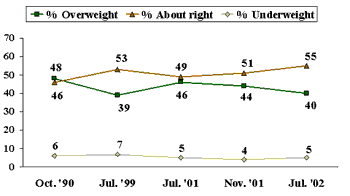
PRINCETON, NJ -- A new Gallup poll shows that 40% of adult Americans say they are overweight, including 6% who say they are "very" overweight. Since 1990, these figures have fluctuated from a high of 48% to a low of 39%, although there is no clear trend.
| How Would You Describe Your Weight? |
 |
But the National Institute of Diabetes & Digestive & Kidney Diseases (NIDDK) suggests that more than half of all Americans, 55%, are overweight, including 22% who are "obese." The NIDDK numbers are based on the reported weight and height of Americans, which are then translated into a Body Mass Index (BMI) score. In November of last year, Gallup asked respondents for their height and weight. Based on their reports (excluding the 5% of respondents who refused to give either one or the other statistic), the Gallup survey showed 19% of Americans with a BMI that put them in the obese category, 38% who were overweight, another 38% with a healthy weight, and 5% underweight -- figures that are much closer to the NIDDK estimates than to the self-perceptions reported in the Gallup surveys.
| Self-Perceptions of Weight More Optimistic Than Body Mass Index (BMI) |
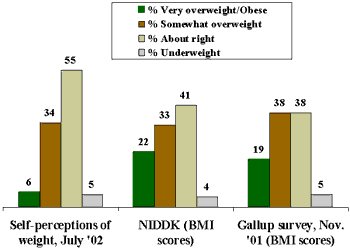 |
These results suggest that many Americans who are overweight according to the BMI scores do not perceive themselves as overweight. This discrepancy is particularly noticeable for the "very overweight" versus "obese" statistics. Both NIDDK and the Gallup survey using the BMI measurement found about one in five (22% and 19%, respectively) Americans "obese," while only 6% of Americans say they are "very" overweight.
Over Half of Overweight People Say They Have Gained Weight in Past Five Years
Forty-four percent of all Americans say they have gained weight over the past five years, including 10% who say they have gained "a lot" of weight. Just 21% say they have lost weight, and 35% say they have stayed at about the same weight. These figures are highly related to people's current weight.
Fifty-eight percent of those who say they are overweight report gaining weight in the past half decade, including 20% who say they have gained "a lot" of weight. By comparison, 35% of those who say their weight is about right say they gained weight, with only 3% saying "a lot" of weight.
Perceptions of Weight Related to Health Ratings
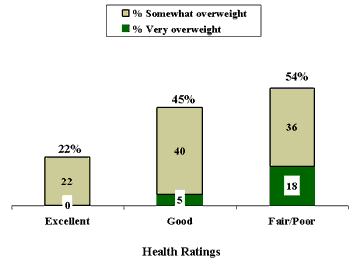
The data in this survey support the widely held view among nutritionists and physicians that being overweight is correlated with a variety of medical conditions and problems. Respondents who rate their health as less than excellent are significantly more likely to say later in the survey that they are overweight.
Overall, more than three-quarters of Americans rate their health as either excellent (30%) or good (47%), while about one in five say it is "just fair" (18%) or poor (4%). Among people who rate their health as excellent, only 22% say they are overweight, and none say they are "very" overweight. But 45% of people who rate their health as good admit to being overweight, including 5% who say "very" overweight. And 54% of those rating their health as only fair or poor say they are overweight, including 18% in the "very" overweight category.
| Lower Health Ratings and Greater Weight |
 |
| July 9-11, 2002 |
Ex-Smokers More Likely to Say They Are Overweight
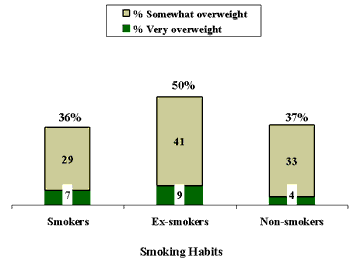
One of the complaints of many people who stop smoking is that they tend to gain weight. The oral satisfaction of cigarettes is often replaced with extra snacks that can lead to weight gains. A comparison of smokers, ex-smokers and people who have never smoked suggests there could be some evidence for this type of reaction. Americans who have never smoked, and those who currently smoke, report about the same incidence of being overweight -- 37% and 36%, respectively. But 50% of ex-smokers report being overweight.
| Ex-Smokers Report Highest Level of Being Overweight |
 |
| July 9-11, 2002 |
Survey Methods
Results are based on telephone interviews with 1,004 national adults, aged 18+, conducted July 9-11, 2002. For results based on the total sample of national adults, one can say with 95% confidence that the maximum margin of sampling error is ±3 percentage points.
In addition to sampling error, question wording and practical difficulties in conducting surveys can introduce error or bias into the findings of public opinion polls.
How would you describe your own personal weight situation right now -- very overweight, somewhat overweight, about right, somewhat underweight, or very underweight?
|
Very |
Somewhat over-weight |
|
Somewhat under-weight |
Very under-weight |
|
|
|
% |
% |
% |
% |
% |
% |
|
|
2002 Jul 9-11 |
6 |
34 |
55 |
5 |
* |
* |
|
2001 Nov 8-11 |
6 |
38 |
51 |
4 |
* |
1 |
|
2001 Jul 19-22 |
5 |
41 |
49 |
5 |
* |
* |
|
1999 Jul 22-25 |
4 |
35 |
53 |
6 |
1 |
1 |
|
1990 Oct 11-14 |
7 |
41 |
46 |
5 |
1 |
* |
|
* Less than 0.5% |
||||||
Thinking about how your weight has changed over the past five years, would you say you have -- [ROTATED: gained a lot of weight, gained a little weight, stayed the same, lost a little weight, (or) lost a lot of weight]?
|
Gained |
Gained |
Stayed |
Lost |
Lost |
No |
|
|
2002 Jul 9-11 |
10% |
34 |
35 |
13 |
8 |
* |
|
* Less than 0.5% |
||||||
