PRINCETON, NJ -- History was made last week when Congress passed a new Medicare bill that -- for the first time in Medicare's history -- creates a prescription drug benefit. The bill has been called the largest expansion of Medicare ever, and will cost at least $400 billion in the long run. President Bush has been extolling the new bill's virtues in speeches across the country and is set to sign it into law.
A review of polling on the topic suggests that Americans generally favor the concept of including the cost of prescription drugs under Medicare, even if it costs $400 billion, although older Americans in particular are skeptical that these changes will make a substantial difference in the long run.
Prescription Drug Use by Seniors Approaches Universality
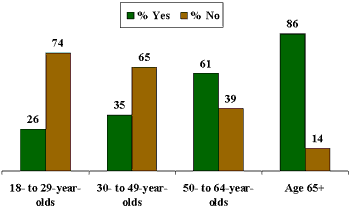
One thing is clear. A sizable proportion of the American adult population, 48%, uses prescription drugs, and that percentage reaches an extremely high 86% among those 65 and older.
| Are you currently taking any prescription medication, or not? |
 |
| Nov. 10-12, 2003 |
Most older Americans who use prescription drugs do so for a long-term illness; just 10% of those 65 and older say their drug use is only for short-term illnesses or conditions. This is significant because it suggests that drugs are a continuing, regular and long-term expense for senior citizens.
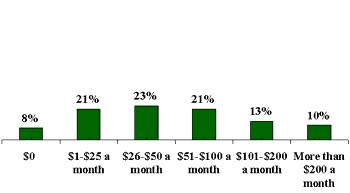
Indeed, Gallup Poll data show that the average senior citizen who uses prescription drugs pays more than $1,600 a year out of pocket for prescription drugs. This is despite the fact that 64% of those who are 65 and older have some type of private insurance that helps them pay for prescriptions.
| What is your best estimate of the total
amount of money you pay out of pocket EACH MONTH for prescription drugs? |
 |
| Nov. 10-12, 2003 |
The average American who uses prescription drugs pays $98 a month out of pocket, and that number increases to $138 a month ($1,656 a year) among those 65 and older.
How Important Is a New Prescription Drug Bill?
All of these figures -- the high rate of prescription drug use and the high out-of-pocket costs incurred to help pay for them -- help explain why expanding governmental Medicare coverage to include prescription drugs has become such an important political issue for Americans.
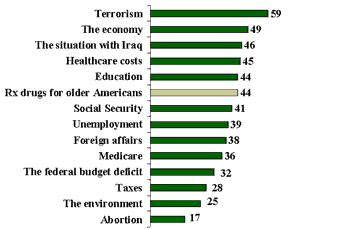
At the beginning of this year, a Gallup Poll asked Americans to rate how important it was that Congress deal with a list of issues and concerns. "Prescription drugs for older Americans" appeared near the top of the list.
| How important is it to you that the
president and Congress deal with each of the following issues in
the next year -- is it -- extremely important, very important,
moderately important, or not that important? % Extremely Important |
 |
| January 3-5, 2003 |
Dealing with terrorism was rated most important (based on the percentage of Americans saying it was extremely important that Congress deal with it), but prescription drugs was part of a group of issues that came in just below terrorism, with between 40% and 50% rating each as extremely important.
Older Americans were slightly, but not overwhelmingly, more likely than younger Americans were to rate prescription drug coverage as extremely important.
|
"Prescription Drugs for Older Americans" |
% extremely important |
|
Total sample |
44% |
|
18 to 29 |
38% |
|
30 to 49 |
42% |
|
50 to 64 |
53% |
|
65+ |
48% |
Basic Support for Concept
With this perceived high importance, it is not surprising to find that Americans are generally supportive of the concept of new legislation to provide prescription drug coverage for older Americans.
It is important to note that there has been no new survey research conducted since the bill passed the Senate last week. Indeed, there is little doubt that it may take a number of weeks, and perhaps months or years, before Americans get a good sense of what the bill entails and how it will affect them personally. Many of the bill's provisions will not take effect until 2006, and as is often the case, the implications of new legislation won't become known until the law actually takes effect. This is particularly true in reference to this bill, which is highly complex and far from straightforward in the benefits it provides. From all accounts, Americans who are 65 and older are quite sensitive to the cost of healthcare, so there is little doubt that the implications of the new law will be scrutinized carefully as it begins to take effect.
A CNN/USA Today/Gallup poll completed last June found 76% support (including 74% of those 65 and older) for a bill that would "spend $400 billion over the next 10 years to create a new Medicare program that would help senior citizens pay for prescription drugs." An ABC/Washington Post poll completed in October showed 75% support for "a new federal program that would help pay prescription drug expenses for senior citizens, at a cost of 400 billion dollars over the next 10 years." A July NBC/Wall Street Journal poll found 70% support for a plan "to help pay a portion of prescription drug costs for senior citizens and certain disabled persons who are insured under Medicare."
Americans Cynical That Bill Will Do Much Good
Despite the high levels of basic support for the concept of including prescription drugs under Medicare, other polling suggests there is a great deal of cynicism about how effective any such legislation will be in the long term. In other words, there is approval for the concept even as there is disbelief that it will end up relieving the prescription drug burden to any great degree.
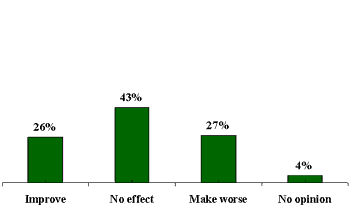
Long before last week's Senate vote on the current bill, Gallup polling showed that senior citizens were as likely to say that a new congressional bill on the issue would make things worse as they were to say that it would make things better.
| Based on what you have heard or read about
the changes Congress is considering making to Medicare, do you
think these will – improve your situation, have no effect, or
make your situation worse? Based on 188 Adults Aged 65 Years and Older |
 |
| Aug. 25-26, 2003 |
These figures are quite revealing. Forty-three percent of senior citizens interviewed in the August Gallup Poll said that "the changes Congress is considering making to Medicare" will have no effect on their personal situations. Twenty-six percent said it would improve things, but just as many, 27%, said that it would make things worse.
Similarly, in a June Gallup Poll, 63% of those 65 and older said that "the new Medicare bill being considered by Congress" would not do enough to help pay the cost of prescription drugs, and that a bill was needed that would do more.
These are not strong expressions of confidence. As noted, these sentiments were measured last summer, and there is a plausible hypothesis that the complex bill passed last week may have reduced confidence in its long-term efficacy even further.
Support Tentative
Perhaps because there is such a high level of cynicism about the eventual impact of new drug legislation, Americans seem quite willing to alter their basic levels of support for the concept of including prescription drugs under Medicare if they are presented with new information and/or arguments why such legislation may not be a good idea.
For example, the June CNN/USA Today/Gallup poll dealing with this issue asked the following question:
|
Do you favor or oppose the following proposal? Instead of most Medicare recipients being enrolled in the traditional fee-for-service Medicare program, most Medicare recipients would be enrolled in private managed care plans. These managed care plans might provide enrollees with additional benefits for no more money, but enrollees would have less choice of doctors and hospitals when seeking care.
|
||||||
|
Favor |
Oppose |
No opinion |
||||
|
% |
% |
% |
||||
|
National Adults |
37 |
59 |
4 |
|||
|
By Age ^ |
||||||
|
18 to 29 years old |
41 |
57 |
2 |
|||
|
30 to 49 years old |
43 |
53 |
4 |
|||
|
50 to 64 years old |
30 |
67 |
3 |
|||
|
65 years and older |
24 |
69 |
7 |
|||
|
^ RESULTS BASED ON 154 18-29 YEAR OLDS (±8 PCT. PTS.), 380 30-49 YEAR OLDS (±6 PCT. PTS.), 257 50-64 YEAR OLDS (±7 PCT. PTS.), AND 191 65 YEARS AND OLDER (±8 PCT. PTS.) |
||||||
As can be seen, this question -- which put an emphasis on the enrollees having less choice of doctors and hospitals as a result of being enrolled in private managed care plans -- invoked a much lower level of support than is measured for the basic concept, with a majority, 59%, opposed to the idea.
Another question recently asked by the University of Pennsylvania's National Annenberg Election Survey was phrased as follows:
Republicans in Congress have agreed on a Medicare bill intended to provide a prescription drug benefit for seniors and to enable private companies like HMO's to provide Medicare coverage. Supporters say the drug benefit is an important first step and private companies will reduce the cost of Medicare. Opponents say the drug benefit won't help many seniors very much and letting HMO's in will eventually destroy Medicare. What do you think? Should Congress pass this bill or not?
The results of this question showed that 40% of all Americans said that such legislation, as described, should be passed, while 42% said it should not. Those over 65 opposed the described bill by a 49% to 33% margin.
This question was measuring responses to a paragraph's worth of information about the bill, information that, among other things, reminded respondents that this was a Republican bill, and implied that it would benefit HMOs. It is likely that these points helped produce such lower levels of support for the bill.
Canadian Drug Use Favored
The new legislation passed by Congress stipulates that Americans should not be allowed to buy drugs from Canada unless and until they have been certified as safe. That provision is important to many involved in the prescription drug situation, since Canadian prescription drugs can be as much as 80% cheaper than the same drug purchased in this country.
Most Americans have their minds made up on this issue; they believe that it should be legal to buy prescription drugs from Canada and other countries outside of the United States.
| As you may know, many Americans now buy prescription drugs from Canada, even though the practice is illegal, because the drugs are cheaper there than in the United States. Do you think Congress and the president should – or should not – make it legal for Americans to buy prescription drugs from Canada and other countries outside the U.S.? |
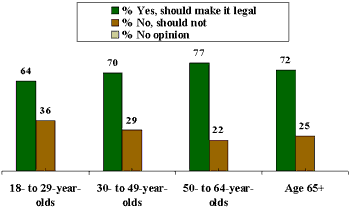 |
| Aug. 25-26, 2003 |
Still, only about 8% of Americans have purchased drugs from Canada, according to an August CNN/USA Today/Gallup poll, including 10% of those 65 and older. We don't have a precise breakout of poll respondents living just in the states that border Canada -- Maine, New Hampshire, Vermont, New York, Michigan, Minnesota, North Dakota, Montana, Idaho, and Washington -- but the data suggest that buying drugs from Canada is more prevalent in the West than any other major region of the country.
Survey Methods
These results are based on telephone interviews with randomly selected adults, aged 18 and older, conducted Nov. 10-12, 2003, June 27-29, 2003,Aug. 25-26, 2003, and Jan. 3-5, 2003. For results based on samples of approximately 1,000, one can say with 95% confidence that the maximum error attributable to sampling and other random effects is ±3 percentage points. In addition to sampling error, question wording and practical difficulties in conducting surveys can introduce error or bias into the findings of public opinion polls. For findings based on subgroups, the sampling error would be greater.
14. Are you currently taking any prescription medication, or not?
|
Yes |
No |
No opinion |
|
|
2003 Nov 10-12 |
48% |
52 |
* |
17. What is your best estimate of the total amount of money you pay out of pocket EACH MONTH for prescription drugs?[OPEN-ENDED]
BASED ON –511—ADULTS WHO CURRENTLY TAKE PRESCRIPTION MEDICATION
|
2003 Nov 10-12 |
|
|
% |
|
|
$0/Nothing |
8 |
|
$1-$25 a month |
21 |
|
$26-$50 a month |
23 |
|
$51-$100 a month |
21 |
|
$101-$200 a month |
13 |
|
More than $200 a month |
10 |
|
No opinion |
4 |
|
Mean |
$98 |
|
Median |
$50 |
24. Based on what you have heard or read about the changes Congress is considering making to Medicare, do you think these will – improve your situation, have no effect, or make your situation worse]?
BASED ON –188—ADULTS AGED 65 YEARS AND OLDER
|
Improve |
No effect |
Make worse |
No opinion |
|
|
% |
% |
% |
% |
|
|
2003 Aug 25-26 |
26 |
43 |
27 |
4 |
|
2003 Jun 27-29 |
20 |
51 |
18 |
11 |
27. As you may know, many Americans now buy prescription drugs from Canada, even though the practice is illegal, because the drugs are cheaper there than in the United States. Do you think Congress and the president should – or should not – make it legal for Americans to buy prescription drugs from Canada and other countries outside the U.S.?
|
Yes, should |
No, |
No |
|
|
2003 Aug 25-26 |
71% |
28 |
1 |
4. How important is it to you that the president and Congress deal with each of the following issues in the next year -- is it -- extremely important, very important, moderately important, or not that important? How about -- [RANDOM ORDER]?
ITEMS A-F: BASED ON –487—NATIONAL ADULTS IN FORM A
ITEMS G-H: BASED ON FULL SAMPLE
ITEMS I-N: BASED ON –513—NATIONAL ADULTS IN FORM B
SUMMARY TABLE: ISSUES SALIENCE
|
2003 Jan 3-5 |
Extremely |
Extremely/Very |
|
% |
% |
|
|
Terrorism |
59 |
90 |
|
The economy |
49 |
91 |
|
The situation with Iraq |
46 |
81 |
|
Healthcare costs |
45 |
81 |
|
Education |
44 |
83 |
|
Prescription drugs for older Americans |
44 |
80 |
|
Social Security |
41 |
77 |
|
Unemployment |
39 |
80 |
|
Foreign affairs |
38 |
78 |
|
Medicare |
36 |
79 |
|
The federal budget deficit |
32 |
68 |
|
Taxes |
28 |
65 |
|
The environment |
25 |
63 |
|
Abortion |
17 |
37 |
