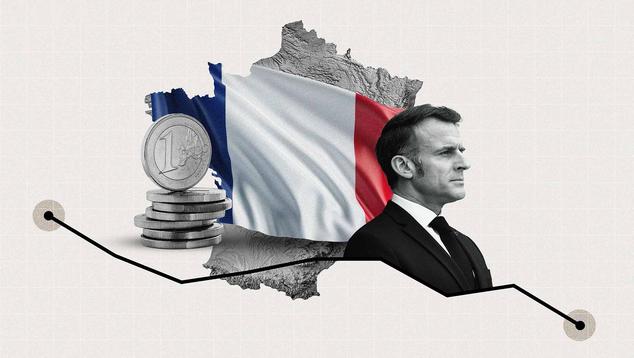
LONDON — In France’s turbulent political environment, the public’s trust in its institutions is sinking and more people are looking for an exit, with the percentage wanting to leave the country more than doubling in the past year.
After years of relative stability, trust in the national government has dropped 13 percentage points to 29% in 2025, while confidence in the honesty of elections has fallen by the same margin to 51%. Confidence in the judicial system has slipped nine points to 50%, and trust in financial institutions has fallen eight points to 42%, reversing years of steady gains. No other European Union country has seen a bigger average drop in confidence across these four institutions in 2025 than France.
France’s sharp loss of faith in its institutions comes amid major political upheaval. Since late 2024, President Emmanuel Macron has cycled through several prime ministers, each struggling to govern without a parliamentary majority. Budget proposals have repeatedly triggered no-confidence votes. Public frustration with the political class and proposed budget cuts has spilled into the streets — most notably, during Gallup fieldwork in September, with the largest union-led protests occurring in France since the 2023 pension reform.
Macron’s Approval Rating Sinks to New Low
Macron’s personal approval rating has also taken a hit this year, dropping to a record-low 28%. This is less than half the level measured during his first year as president, a 61% reading in 2017. Despite the significant decline, Macron’s rating remains slightly higher than that of his predecessor, François Hollande, who ended his term with an approval rating of 19%.
Desire to Migrate More Than Doubles
Amid the turbulence at home, greater numbers of people would like to leave France. This year, 27% of French adults say they would like to move abroad permanently if they had the opportunity, more than double the percentage from last year (11%). While final data from the Gallup World Poll are not yet available for all countries in 2025, this 16-point increase is an annual jump relatively unmatched worldwide since Gallup started asking this question globally in 2007.
Among French adults who would like to move abroad, the top destinations are Canada (15%), Switzerland (8%), Spain and Algeria (both 6%).
The desire to leave France is closely tied to institutional confidence. Those who express confidence in only one or none of five national institutions measured are much more likely to say they would move to another country permanently if given the opportunity (49%), compared with those who have higher levels of trust in national institutions.
Corruption Concerns Reach Decade High
Alongside declining confidence in national institutions and approval ratings, perceptions of corruption have climbed this year. In 2025, 68% of French adults say corruption is widespread throughout the government, an increase of 13 points over the past year. While French people have long perceived government corruption, the current percentage who feel this way now matches the previous high from 2015.
Perceptions of corruption within French businesses (53%) have also risen this year, although not by as much as views of government corruption. This suggests that the public sees corruption in France as distinctly more political and widespread this year than last.
This increase over the past year has come amid heightened attention to several legal cases involving politicians in allegations of corruption. Former President Nicolas Sarkozy was convicted of illegal campaign financing, and Marine Le Pen was barred from running for public office for misappropriating EU funds.
Similar concerns have extended into the current government, where Minister of Culture Rachida Dati and Minister of Justice Gérald Darmanin have each faced corruption charges or legal complaints in separate cases, further fueling public debate about accountability in politics.
Sour Economic Mood Persists
Pessimism about the economy, meanwhile, remains entrenched in the eurozone’s second-largest economy. In 2025, about one in five French adults (21%) say their local economy is getting better, while 67% say it is getting worse, on par with 2024.
Over the past decade, France has been one of the most pessimistic countries within the Organisation for Economic Co-operation and Development (OECD) regarding the state of its economy. Since 2015, only Greece has shown greater average pessimism about its economy than France among OECD countries.
The French public’s discontent with its institutions, leaders and economy may also reflect the mounting economic challenges the country faces. France carries one of the largest deficits in the developed world, and its government spending as a share of GDP exceeds that of any other advanced economy.
Over the past decade, productivity has declined sharply, eroding tax revenues and widening the deficit even further. These economic struggles have fueled recent political instability, with repeated failures to pass spending legislation contributing to the frequent turnover of prime ministers.
Bottom Line
France’s year of political instability is reflected in the nation’s mood. Confidence in institutions and leadership approval have sunk, perceptions of corruption have risen, and economic optimism remains scarce. More people are saying they would like to leave the country for good if they had the chance, particularly those lacking faith in national institutions.
Despite repeated difficulties in forming a stable government — going through three prime ministers since Gallup's 2024 survey of France — Macron has continued to face down domestic pressure. His presidential term comes to an end in May 2027. The task for whoever follows him will be rebuilding the public trust that eroded late in his tenure.
Stay up to date with the latest insights by following @Gallup on X and on Instagram.
For complete methodology and specific survey dates, please review Gallup's Country Data Set details. Learn more about how the Gallup World Poll works.