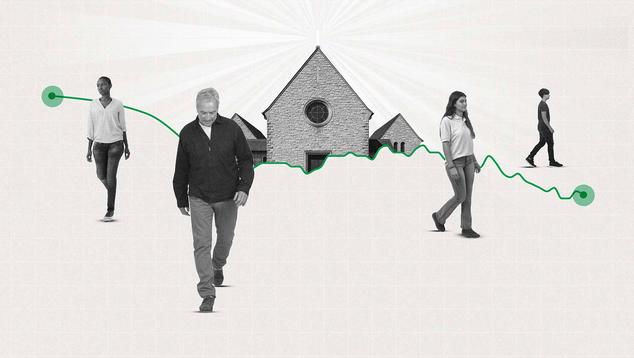
WASHINGTON, D.C. — The percentage of Americans who say religion is “very important” in their lives has leveled off below 50% in recent years, including 47% in 2025. The reading has been gradually declining from 58% in 2012 and was as high as 70% to 75% in the 1950s and 1960s.
Meanwhile, in each year since 2022, 28% of Americans have said religion is “not very important” in their lives. This is the highest proportion in Gallup’s trend and more than double the rate seen as recently as the early 2000s. Another 25% today, down only slightly over the long term, say religion is “fairly important” to them.
These figures are from Gallup’s annual averages of Americans’ religious views, with the latest results based on surveys conducted in May and December 2025.
Looking at the data in five-year increments over the past 25 years allows for a closer examination of how views about religion have shifted within demographic groups over time. Except for Catholic and Jewish Americans and Republicans, most groups have experienced significant declines in the percentage who say religion is very important in their lives.
In the 2001-2005 period, majorities in nearly all demographic groups said religion was very important. The main exceptions were young adults, Jewish adults, higher-income Americans and residents of the West.
In 2021-2025, six of these groups continue to be highly religious, with between 55% and 67% saying religion is very important to them: Latter-day Saints, Republicans, Protestant or nondenominational Christians, Black adults, adults aged 65 and older, and Southerners. Slim majorities of several other groups — lower-income Americans, women and those aged 50 to 64 — also say religion is very important.
On the other end of the spectrum, Jewish adults (32%) and those aged 18-29 (33%) are the least likely to consider religion to be very important in their lives.
The largest declines on this measure over the two five-year periods have been among Democrats (down 23 percentage points, to 37%) and Black adults (down 22 points, to 63%). The only group that has become more likely to say religion is very important is Jewish adults (up 10 points to 32%).
Religious “Nones” Edged Up to New High in 2025
The decline in the share of Americans who say religion is very important to them has coincided with a broader rise in those who report having no religious affiliation, often referred to as the “Nones.” Their ranks have grown from 2% in 1948 to more than 20% in recent years.
Last year, the “Nones” hit a new high of 24%, after four years in the 21% to 22% range. This is based on interviews with more than 13,000 U.S. adults across Gallup’s monthly 2025 surveys. At the same time, 44% of Americans in 2025 identified as Protestant or nondenominational Christian, 20% as Catholic and 9% as another religion.
Just as adults younger than 30 are the age group least likely to say religion is very important to them, they are also the one least likely to identify with a religion. Thirty-five percent of young adults in this age group say they do not have a religion, compared with 29% of those aged 30 to 49, 18% of 50- to 64-year-olds and 14% of adults 65 and older.
Much of the drop in religious affiliation in the U.S. during the past two decades can be attributed to generational change, as younger adults, who are significantly more likely to have no religious identity, are gradually replacing older generations that had comparatively few unaffiliated individuals.
Religious Service Attendance Remains Low
The long-term trend in religious service attendance shows a steady decline in regular attendance alongside a sustained increase in nonattendance over the past two-plus decades. From the early 1990s to 2008, majorities of U.S. adults said they attended services at least monthly, but since 2018, majorities have said they rarely or never attend religious services.
In 2025, 57% of Americans on average said they seldom or never attend, and 31% reported attending weekly or nearly weekly. Attendance about once a month has been relatively steady during the trend, and was at 10% in 2025.
Young adults, both those with and those without a religious preference, are less likely to participate in religious services, with 25% reporting almost weekly or weekly attendance, 13% monthly attendance and 61% seldom or never going. In contrast, 37% of adults aged 65 and older say they attend almost weekly or weekly, 9% monthly and 51% seldom or never.
Bottom Line
Americans’ relationship with religion continues to evolve, marked by fewer adults describing religion as central to their lives, rising religious nonaffiliation and persistently low levels of religious service attendance. While religion remains deeply important to major segments of the population (Republicans, Protestants, Black adults, older Americans and Southerners in particular), the long-term trajectory shows a steady decline driven largely by generational replacement. Younger adults are both less likely to identify with a religion and less likely to attend services, reshaping the nation’s religious landscape as they constitute a growing share of the population.
Stay up to date with the latest insights by following @Gallup on X and on Instagram.
Learn more about how the Gallup Poll Social Series works.