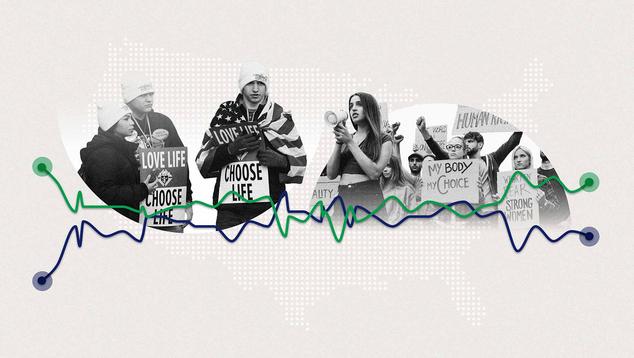
WASHINGTON, D.C. — Four years after the Supreme Court’s Dobbs v. Jackson Women’s Health Organization decision overturned Roe v. Wade, Gallup's core trends show that the shifts in Americans’ attitudes on abortion, first recorded right after a draft of the ruling was leaked, have held steady.
According to Gallup’s May 1-17 Values and Beliefs poll, 48% of Americans would prefer abortion be legal in all (33%) or most (15%) circumstances, while 49% prefer it to be illegal (17%) or legal in only a few circumstances (32%). This split is similar to the close division of views on legality generally seen since 2022, but it contrasts with the quarter century before, when majorities of Americans consistently favored having abortion be legal in only a few circumstances or not at all.
In May 2022, shortly after Dobbs was leaked, 53% of Americans said they favored laws allowing abortion to be legal in all or most circumstances, reaching the majority level for the first time in the trend.
Large partisan differences remain, with 75% of Democrats versus 15% of Republicans saying abortion should be legal in all or most circumstances. Independents’ views fall in the middle, with 48% favoring broad legality.
Additionally, the unusually wide gender gap reported last year persists, with 55% of women today saying abortion should be legal in all or most circumstances, compared with 38% of men.
Steady Position on Morality of Abortion
Americans’ views on the morality of abortion are also generally consistent with where they’ve been since 2022. Forty-nine percent say abortion is morally acceptable, 41% say it is morally wrong, and 8% think it depends on the situation.
In 2021, the year before the Dobbs decision, Americans were narrowly split on the moral acceptability of abortion, with 46% saying it is morally wrong and 47% morally acceptable. Since 2022, at least a plurality of Americans have consistently reported that abortion is morally acceptable.
Gender and party differences in Americans’ attitudes about the morality of abortion are similar to their views on legality. Fifty-six percent of women say abortion is morally acceptable, versus 39% of men. Seventy-three percent of Democrats agree, compared with 18% of Republicans and 49% of independents. This is among the largest partisan gaps observed for the behaviors measured in this poll.
More Americans Identify as Pro-Choice Than Pro-Life
Gallup’s 2022 post-Dobbs leak poll found a majority of Americans identifying as “pro-choice,” the first time since 2006. The proportion has been largely unchanged since 2022, sitting at 53% today. Meanwhile, 42% of Americans currently describe themselves as “pro-life,” also similar to where it’s been since 2022. The recent division contrasts with most years between 2009 and 2021, when pro-choice/pro-life identification was closely divided.
More than four in five Democrats (81%) identify as pro-choice, compared with 17% of Republicans and 54% of independents. Though statistically unchanged from last year, this represents shifts of 11 points among Democrats and five points among Republicans since 2021, before the Dobbs decision.
More women (56%) than men (48%) identify as pro-choice, reflecting the persistent Dobbs effect that has impacted women’s attitudes more strongly than men’s. The percentages of men and women identifying as pro-choice in 2026 are not statistically meaningful changes from 2025.
Bottom Line
Four years after the Dobbs leak, the shift in Americans’ abortion attitudes that followed the high court’s ruling has become the new normal. A slight majority of U.S. adults continue to identify as pro-choice, and a plurality consider abortion morally acceptable. The country has shifted from leaning toward more restrictive abortion laws to being split between restrictive and expansive laws.
Reflecting this division, laws governing abortion access vary widely from state to state, with 13 states adopting a total ban on abortion with few exceptions. Attitudes shifted after Dobbs but have remained steady since, as the issue continues to play out in the legal system, such as the Supreme Court’s recent decision to allow the abortion pill mifepristone to remain available via telehealth appointments.
Stay up to date with the latest insights by following @Gallup on X and on Instagram.
Learn more about how the Gallup Poll Social Series works. View complete question responses and trends (PDF download).