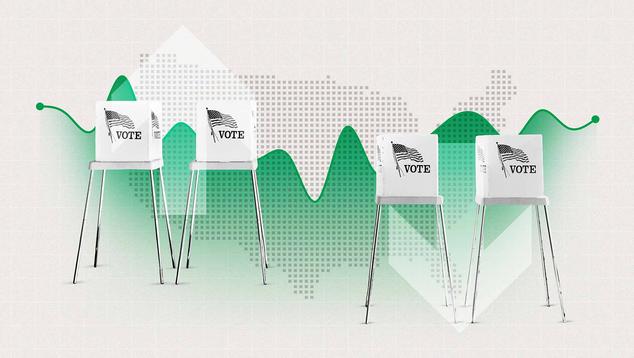
WASHINGTON, D.C. — With the midterms approaching, Americans are divided in their views of the honesty of U.S. elections. Forty-nine percent are confident in electoral honesty, while 51% are not. Americans’ relative lack of confidence in the integrity of elections is nothing new — it has averaged 45% since 2006 — but who lacks confidence is.
In 2026, 63% of Democrats are confident in the honesty of elections, higher than either Republicans (37%) or political independents (35%). The World Poll has asked about party identification in the U.S. only since 2024, when there was a 55-percentage-point divide in confidence between Democrats and Republicans. This divide closed to just four points in 2025 but has reopened this year, despite Republicans controlling both the White House and Congress.
Views of national leadership share significant overlaps with party identification. The remainder of this article focuses on leadership approval to allow for political subgroup analysis before 2024 and to facilitate comparisons with other countries. In 2026, confidence in the honesty of elections is, for the first time, significantly higher among Americans who disapprove (52%) of their country’s leadership than approve (41%), a pattern that has not been seen in any other country over the past 15 years.
Long-Standing Confidence Gap by Leadership Views Vanishes
From 2006 to 2020, there was a consistent and large gap in electoral confidence between Americans who approved of and those who disapproved of U.S. leadership under the administrations of George W. Bush (averaging 35 points), Barack Obama (averaging 30 points) and Donald Trump (averaging 35 points).
After Joe Biden won the presidency in the 2020 election, the results of which Trump challenged, this confidence gap ballooned to 51 points. Those disapproving of U.S. leadership under Biden (mostly Republicans) had similarly low levels of confidence (averaging 30%) as under previous administrations, but approvers (mostly Democrats) became far more confident (averaging 81%).
Since 2025 and Trump’s return to the White House, the relationship between leadership approval and confidence in elections has disappeared. Over the past two years, an average of 46% of approvers have expressed confidence in the honesty of elections, compared with 48% of disapprovers.
The collapsing of the gap is a result of two factors. The first is that the composition of the approver and disapprover groups has changed. Approvers shifted from being a Democratic-leaning group under Biden to a Republican-leaning group under Trump, while disapprovers showed the reverse pattern. And, although Democrats remain more confident in U.S. elections than Republicans, Democratic confidence is lower under Trump than it was under Biden, while Republicans’ confidence is now higher under Trump.
U.S. Now a Global Outlier on Confidence in Elections
The current U.S. pattern is highly unusual compared with the rest of the world. In the more than 100 countries where Gallup asks about election confidence and leadership approval annually, those approving of their country’s leadership nearly always have higher levels of confidence than those disapproving, a relationship that holds across all types of political systems. In 2025 (with final global data collection not yet complete in 2026), a median of 70% of approvers of their national leadership had confidence in the honesty of their elections, compared with 30% of disapprovers — a gap of 40 points.
The 2026 U.S. data highlight how unique the country is in this regard, with the gap between approvers and disapprovers now 11 points in the opposite direction. This also marks a change from 2025, the first year of Trump’s second term, when confidence was nominally higher among approvers (51%) than disapprovers (45%).
No other country in the world in the past 15 years has seen this pattern, in which people disapproving of their leadership are significantly more confident in the honesty of elections than those approving of their leadership.
Bottom Line
As Americans cast ballots in this fall’s midterm elections, they do so amid a highly unusual dynamic. Rather than the typical global pattern, in which supporters of the winning party in the last election trust the election process much more than supporters of the losing party, the gap between them has narrowed and reversed direction. This raises real questions about whether some voters will see November's results as legitimate.
Stay up to date with the latest insights by following @Gallup on X and on Instagram.
For complete methodology and specific survey dates, please review Gallup's Country Data Set details. Learn more about how the Gallup World Poll works.