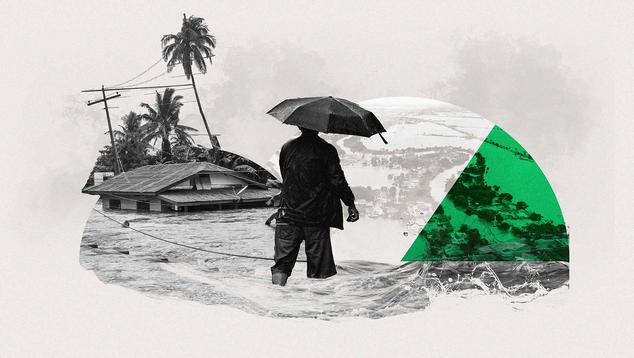
LONDON — The effects of disasters related to natural hazards like floods and earthquakes fall disproportionately on the most vulnerable, according to the Lloyd’s Register Foundation World Risk Poll. In low-income countries, nearly one in three adults (31%) say they have personally been impacted by a disaster related to a natural hazard in the past five years, significantly higher than those in middle- and high-income countries and the global average (20%).
These findings come from a new Lloyd’s Register Foundation report, From Alert to Agency, examining the relationship between disasters, early warning systems and resilience around the world, based on people’s experiences across 140 countries surveyed throughout 2025.
People in high-income countries enjoy greater protection from the effects of disasters than those in low-income countries, given that their countries typically have more resilient infrastructure and early warning systems. Accordingly, of the 10 countries that rank highest for self-reported impacts from disasters, nine are classified as low-income or lower-middle-income (alongside Hong Kong), and eight are located in sub-Saharan Africa, although the Philippines ranks highest globally at 80%.
Vulnerable People Within Low-Income Countries Also Impacted More
Disasters weigh most heavily not only on the populations in low-income countries but also on the most vulnerable people within them. The percentage of people affected by disasters in low-income countries is highest among the poorest households, with 36% of those in the poorest 20% reporting impacts, compared with 27% in the richest 20%. Such differences are not present in upper-middle-income or low-income countries, where similar percentages report disaster impacts regardless of income level.
No Link Between Disaster Impacts and Individual Resilience in Low-Income Countries
The idea of resilience — people’s ability to bounce back from shocks and disasters — is another core focus of the World Risk Poll. Throughout most of the world, people affected by disasters exhibit higher levels of individual resilience than those not affected by disasters. But that relationship is not seen in low-income countries.
The individual dimension of the World Risk Poll Resilience Index combines people’s education level with their feelings of agency — how able they are to protect themselves from a future disaster — resulting in a score out of 100. In low-income countries, there is an individual resilience gap of one point between those impacted by disasters and not, compared with at least eight points or more in all other income bands, with those impacted scoring significantly higher on individual resilience.
Low-Income Countries Are Least Prepared for Disasters
Preparedness is an important factor in disaster resilience, which comprises several elements. On many of those elements, people in low-income countries report lower preparedness than those in wealthier ones. At the individual level, 42% of adults in low-income countries say they could protect themselves in a future disaster, considerably lower than those in upper-middle-income (53%) and high-income countries (56%), but higher than those in lower-middle-income countries (33%).
Fewer than one in three adults in low-income countries (29%) also have a household plan in place to cope with a future disaster, in line with lower-middle-income countries but significantly lower than upper-middle- and high-income countries. Such low levels of household planning and personal agency may partly explain why people report such high levels of disaster impacts in low-income countries.
Confidence in local authorities to cope with disasters is also low: 40% in low-income countries say their local government is well-prepared to deal with a disaster, compared with 58% in middle-income countries and 45% in high-income countries.
Some low-income countries score well on individual measures, but none perform above average on all three. Madagascar and Mali, for example, score above average on feelings of agency and perceptions of local government preparedness, but not on household planning. Conversely, Liberia, Mozambique and Malawi all score above average on household planning but not on agency and local government preparedness. Not all low-income countries are unprepared for disasters, but building blocks of preparedness rarely coexist in equal strength.
Residents in Low-Income Countries Also Worry More About Severe Weather Events
In addition to having the highest levels of reported disaster impacts and among the lowest levels of preparedness, low-income countries are home to the highest levels of worry about weather-related risks. About half of adults say they are “very worried” about being seriously harmed from severe weather events like floods and storms (52%) and prolonged weather events like droughts and heat waves (49%), while 44% say the same about wildfires.
The percentages of people worried about weather risks in middle- and high-income countries are significantly lower than in low-income countries.
Bottom Line
Disasters related to natural hazards affect many parts of the world, yet people living in low-income countries — particularly the most vulnerable within them — report more impacts, and less preparedness, than anyone else.
This new report is launched amid the strongest El Niño on record, a climate phenomenon that causes major shifts in global weather patterns and increases the likelihood of floods in some regions and extreme heat in others. As a result, the effect of weather events on vulnerable people and places could be even more significant in the next year.
Read more in the World Risk Poll report, From Alert to Agency, from Lloyd’s Register Foundation.
Stay up to date with the latest insights by following @Gallup on X and on Instagram.
For complete methodology and specific survey dates, please review Gallup's Country Data Set details. Learn more about how the Gallup World Poll works.