LONDON — Living in a high-income country does not guarantee that people feel their governments and communities care about them. Adults in high- and low-income countries are equally likely to say their governments and communities do not care about them at all, according to a new analysis from the Lloyd’s Register Foundation World Risk Poll.
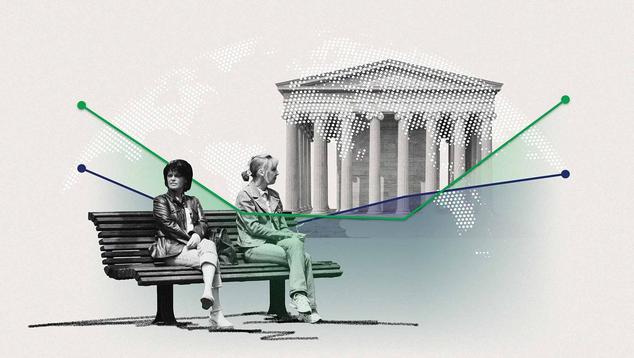
Across 140 countries, 29% of adults globally say their government does not care about them or their wellbeing at all. This figure reaches 44% in low-income countries and 45% in high-income countries, compared with about one in four adults in lower-middle-income (25%) and upper-middle-income (24%) countries. The results create almost a "U-shape" in perceived care along the lines of national income, which offers an alternative view of societal progress beyond objective indicators such as gross domestic product.
A similar but less pronounced pattern appears for perceptions of community care. About one in three adults in low-income (33%) and high-income (32%) countries feel no care at all from their neighbors, higher than those living in lower-middle-income (21%) and upper-middle-income (28%) countries and above the global average of 26%.
Perceived care is measured using a three-point scale (“a lot,” “somewhat” and “not at all”). On both measures, people in high-income countries are less likely than those in low-income countries to say they feel a lot of care from governments and neighbors. Taken together, this means people in high-income countries feel less cared for overall than those in any other national income bracket.
The Lloyd’s Register Foundation World Risk Poll measures perceptions of care because these are important foundations of resilience. When people feel that their neighbors and governments care about them, they are better positioned to support one another and recover from shocks.1
These findings are included in a new report — A Resilient Life: How Wellbeing Shapes the Capacity to Cope — that examines global trends in resilience.
Regional Variations in Care Perceptions
Perceptions of feeling cared about also differ by region. On government care perceptions, Latin America and the Caribbean stands out for its high proportions of adults feeling no care at all, including Bolivia (78%), Peru (77%), Panama (74%), Paraguay (73%), Colombia (72%) and Honduras (71%).
Countries in sub-Saharan Africa also rank highly for reporting lack of care from governments, including Comoros (83%), Madagascar (70%) and the Republic of the Congo (67%), as do several high-income countries in Western Europe, such as France (55%), Portugal (54%) and Italy (49%).
There are similarities between the global maps for perceived care from governments and from neighbors, but some differences as well. Many countries across Latin America are also highly negative on the measure of care from neighbors, as are those in Eastern Europe, including Russia (59%), Ukraine (48%) and Bulgaria (49%) — all of which are more than 20 percentage points above the global average.
While perceptions of care from neighbors and governments generally align within most countries, they differ considerably in others. In the United States, 58% feel the government does not care about them at all, compared with 17% for neighbors — a gap of 41 points, one of the largest in the world. Russia, by contrast, sees a gap of a similar magnitude in the other direction, where 59% feel their neighbors don’t care about them, but only 23% say the same about the government.
U-Shape Also Visible in Reported Experiences of Discrimination
There is a similar U-shaped relationship between national income and self-reported experiences of discrimination, another important element of resilience alongside wider perceptions of care.
The World Risk Poll asks people whether they have ever experienced discrimination based on skin color, religion, ethnicity, gender or disability. About one in three adults in low-income (35%) and high-income (31%) countries say they have experienced one of these forms of discrimination in their lifetime, far higher than the 22% who report discrimination in middle-income countries.
The poll does not ask about other forms of discrimination, such as those based on sexuality, age or socioeconomic status. People's perceptions of what counts as discrimination can be influenced by cultural and individual factors, national diversity, legal frameworks, and histories of segregation or conflict, as well as many other elements.
In high-income countries, experiences of discrimination are linked to perceptions that governments do not care about their people. The more types of discrimination people say they have experienced, the more likely they are to say their government does not care about them at all. Among those who report none of these forms of discrimination, 41% say the government doesn't care about them, rising to 65% among those who report experiencing at least four types of discrimination. There is no such relationship with perceived care from neighbors.
This pattern is unique to perceptions of governments in high-income countries, as neither relationship shows a similar gradient throughout the rest of the world. In wealthy countries, experiences of unequal treatment appear to be more associated with how people view institutions than how they view their communities.
Bottom Line
A country’s resilience is determined by many factors, including, but not limited to, national income. While wealthier countries typically have more resilient infrastructure, higher levels of personal agency and more advanced disaster warning systems, they score somewhat lower on communal and social measures of resilience.
In terms of perceived care from both neighbors and governments, and reports of discrimination, adults in high-income countries feel similarly to those in low-income countries, despite the vast divides in national prosperity separating them. While feelings of care are an important part of flourishing communities and countries, they do not follow naturally from wealth. They must be fostered at the community and societal levels to bring about a more resilient future.
Read more in the World Risk Poll report, A Resilient Life: How Wellbeing Shapes the Capacity to Cope, from Lloyd’s Register Foundation.
Stay up to date with the latest insights by following @Gallup on X and on Instagram.
For complete methodology and specific survey dates, please review Gallup's Country Data Set details. Learn more about how the Gallup World Poll works.
Footnotes
[1] Aldrich, D., & Meyer, M. (2014). Social capital and community resilience. American Behavioral Scientist, 59(2), 254-269.