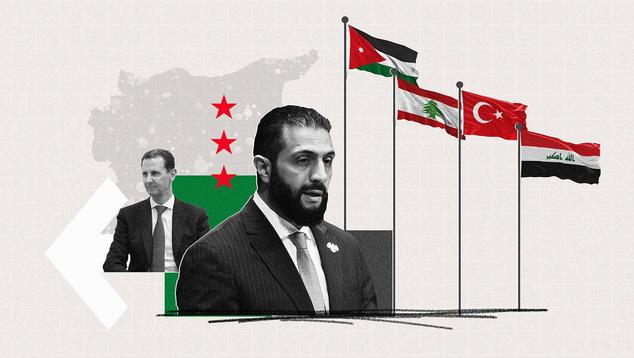
WASHINGTON, D.C. — One year after Syrian rebels ousted President Bashar al-Assad from Damascus, ending more than five decades of family rule, the region is still adjusting to Syria’s new leadership. However, residents in three out of four neighboring countries remain broadly optimistic that his fall will improve life for the Syrian people.
Optimism about what the change means is highest in Jordan, where 60% of residents expect a positive effect. Views are also more positive than negative in Lebanon (45% vs. 34%) and Türkiye (40% vs. 26%). Iraqis, however, stand out for their pessimism, with nearly half (46%) saying the change will negatively affect Syria, while 27% expect it to be beneficial.
Though the Assad government was already largely hollowed out by more than a decade of war and hadn’t controlled all of its territory since 2011, people in neighboring countries are concerned about the effect its fall will have on their own country. Despite prevailing optimism for how the regime change in Syria will affect Syrians’ lives, residents in all four neighboring countries surveyed (this question was not asked in Israel) are less sanguine about its impact on their own country.
Nearly half of Jordanians (49%) and one in seven Iraqis (15%) say Assad’s fall will affect their own country in a positive way, at least 10 percentage points lower than those saying his ouster will affect Syria positively.
Security Concerns Temper Regional Optimism
On the topic of security, only Jordanians believe the fall of the Assad regime will have more of a positive impact than a negative one (48% vs. 14%). In both Türkiye (35% vs. 38%) and Lebanon (32% vs. 42%), the populations are more divided, but neither shares the clear optimism that Jordanians have about their own country’s security.
Türkiye’s shared border with Syria has seen refugee flows and power shifts among various armed groups since the beginning of Syria’s civil conflict. Meanwhile, Lebanon has long experienced Syrian influence over its politics and security, a fear now exacerbated by the militant backgrounds of Syria’s new rulers.
Among Iraqis, a slim majority of adults (52%) believe the fall of the Assad regime will affect security in their country negatively, about three times as many as those who believe it will have a positive effect (17%).
Viewing Assad’s Fall Through a Sectarian Lens
Despite ruling over a country where roughly 60% of the population are Sunni Arabs, Assad and his most loyal core of supporters hailed from Syria’s 10% Alawite minority, a distinct religious group with ties to Shia Islam. As the Syrian military weakened over years of conflict, it increasingly relied on support from Shia allies like Iran and Hezbollah, while much of the opposition consisted of Sunni Muslim groups, deepening the war’s sectarian dimension, even though the conflict was also driven by political, ethnic and regional factors.
The sectarian angle to Syria’s conflict is evident in how residents of neighboring countries view developments in Syria against their own interests. In Iraq, a country with its own recent history of sectarian conflict, 64% of Shia Muslims say the overthrow of Assad will have a negative effect on their country, significantly higher than the rate of Sunni Iraqis who say the same (39%).
A similar effect is seen in Lebanon, where 67% of Shia say the fall of Assad will be negative for their country, three times the rate among Sunnis (22%).
In Lebanon, Gallup also asked respondents if they believe the new Syrian government would respect the rights of ethnic and religious minorities. Majorities of Lebanese Druze (67%), Shia (71%) and Christians (72%) said they believe it will not. Only Lebanese Sunnis believe the new Syrian government will work to preserve Syria’s rich ethnic and religious diversity.
Bottom Line
Syrian rebels shocked the world last December by defeating Assad’s army in just 10 days (after breaking out of Idlib province). After 13 years of conflict, putting the country back together always promised to be a difficult task, and serious issues remain today regarding the future of the country.
Syria’s new president, Ahmed al-Sharaa, has prioritized restoring the country’s ties with global partners and building relationships with both Gulf countries and Western governments. He recently became the first Syrian head of state to visit the White House. Still, following massacres of both Druze and Alawite minority groups earlier this year, the world waits to see if Damascus’ new leaders will truly rule the country on behalf of all groups or remain a poorly governed security concern for its neighbors and beyond.
Stay up to date with the latest insights by following @Gallup on X and on Instagram.
For complete methodology and specific survey dates, please review Gallup's Country Data Set details. Learn more about how the Gallup World Poll works.