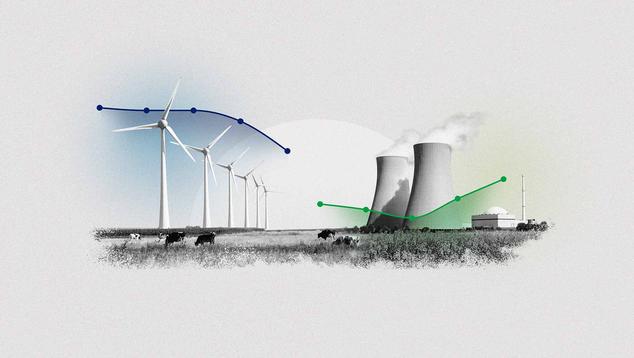
WASHINGTON, D.C. — Majorities of Americans continue to prefer that the U.S. put more emphasis on solar and wind power for domestic energy production, but fewer now hold that view than in any of five measurements over the past 13 years. At the same time, support for greater emphasis on nuclear power has risen to its highest point to date, at 46%. Levels of support for increased use of fossil fuels like oil, coal and natural gas remain well below their highs.
Democrats are more likely than Republicans to favor more emphasis on renewable energy sources, while Republicans are more likely to back greater emphasis on fossil fuels. Partisans’ views are most similar on nuclear energy.
Even as there is growing support for more emphasis on nuclear energy, a majority of Americans remain broadly resistant to the construction of a nuclear power plant in their area.
The latest findings are from Gallup’s March 2-18 annual Environment poll.
Emphasis on Solar and Wind Still Preferred Over Other Energy Sources
When asked whether the U.S. should put more emphasis, less emphasis or about the same emphasis as it does now on producing domestic energy from each of six sources, 66% of Americans prefer more emphasis on solar energy and 55% on wind. Though still majorities, both have slipped considerably since the previous reading in 2021, with solar down seven percentage points and wind down 11 points.
Meanwhile, nuclear energy is the only one of the six sources to see support grow since 2021, rising seven points to 46%, making it the plurality response. This shift is notable given that preferences for nuclear energy had historically been more evenly divided among responses of more, less and the same.
Support for more emphasis on natural gas remains the plurality opinion, at 42%, but is down seven points from the prior measurement; 22% prefer less emphasis on natural gas, and 37% prefer the same level.
Views on oil are divided, with 34% preferring more emphasis on it, 37% less and 28% no change. Coal draws the least support of any source asked about, with just 23% of Americans favoring more emphasis, half preferring less and 25% the same amount. These figures have held roughly steady since 2013, with slightly more now preferring less emphasis.

Line graphs. The chart shows Americans’ preferences for emphasizing six energy sources from 2013 to 2026, and the most recent data in 2026 indicate that solar power has 66% saying more emphasis, 17% the same and 16% less, wind has 55% more, 20% the same and 24% less, nuclear power has 46% more, 26% the same and 25% less, natural gas has 42% more, 35% the same and 22% less, oil has 37% more, 28% the same and 34% less and coal has 23% more, 25% the same and 50% less.
Partisan Agreement Greatest on Nuclear Energy
Broad majorities of Democrats and Democratic-leaning independents express a preference for more emphasis on solar (87%) and wind (81%) power, compared with 38% and 22%, respectively, of Republicans and Republican-leaning independents. These partisan gaps of 59 points for wind and 49 points for solar are the largest of the six energy sources. Republicans’ preferences for more emphasis on solar and wind have declined considerably since 2019, to their lowest points this year.
In contrast, majorities of Republicans favor more emphasis on natural gas (59%), oil (54%) and nuclear power (52%). Far fewer Democrats prefer greater emphasis on natural gas (28%) and oil (17%).
Democrats have become significantly more likely since 2021 (up 10 points, to 42%) to want increased emphasis on nuclear power, while Republicans’ views have edged up gradually since 2019. The current 10-point partisan gap in views of nuclear power is the narrowest of any energy source in the survey.
Minorities of Republicans (39%) and Democrats (9%) want greater emphasis on energy from coal. However, whereas Republicans are divided on whether there should be more or the same amount (36%) of emphasis on coal, the broad majority of Democrats, 72%, favor less.

Line graphs. The chart shows partisan preferences for emphasizing six energy sources from 2013 to 2026, and the most recent data in 2026 indicate that Democrats and Democratic leaners have 87% for more emphasis on solar, 81% on wind, 42% on nuclear, 28% on natural gas, 17% on oil and 9% on coal, while Republicans and Republican leaners have 38% for solar, 22% for wind, 52% for nuclear, 59% for natural gas, 54% for oil and 39% for coal, showing higher support among Democrats for renewables and higher support among Republicans for fossil fuels and nuclear.
Despite Higher Nuclear Support, Local Opposition Persists
Over half of Americans, 53%, say they would somewhat (19%) or strongly (34%) oppose construction of a nuclear power plant in their area, compared with 45% who would somewhat (18%) or strongly (27%) favor it. Local resistance to nuclear infrastructure is less pronounced than it was in the five prior readings on this measure from 2001 to 2007, when opposition was 13 to 29 points higher than support.
Seventy-one percent of Americans who want more emphasis on nuclear energy favor building a nuclear power plant in their local area. Conversely, 86% of those who prefer less emphasis on nuclear power oppose constructing a nuclear plant in their area.
In addition, women are more resistant than men to local nuclear power plant construction, with 67% opposed compared with 38% of men. The partisan divide is 19 points, with 59% of Republicans favoring such construction and the same share of Democrats opposing it.
Age also plays a role, with higher opposition among Americans aged 55 and older. Whereas younger adults aged 18 to 34 are nearly evenly split, with 50% in favor and 47% opposed, 39% of those aged 55 and older favor construction of a nuclear plant in their area and 59% oppose it.
Bottom Line
Americans’ preference for emphasizing solar and wind power, while still commanding majority support, has fallen, while nuclear energy has seen its support rise to its highest point to date. The percentages of Americans wanting increased reliance on fossil fuels remain well below their peaks, with coal drawing the least support of any source tested.
Stay up to date with the latest insights by following @Gallup on X and on Instagram.
Learn more about how the Gallup Poll Social Series works. View complete question responses and trends (PDF download).