WASHINGTON, D.C. — Global hunger and food insecurity continued to decline in 2025, extending the recovery from the COVID-19 pandemic, according to estimates from the latest The State of Food Security and Nutrition in the World (SOFI) report.
Despite the recent progress, both hunger and food insecurity remain above pre-pandemic levels and uneven across regions. Hundreds of millions of people continue to experience hunger, leaving the world off track to achieve Sustainable Development Goal 2 of ending hunger by 2030.
The report, released last month, draws on data from many sources — including data on food security collected by the Food and Agriculture Organization of the United Nations (FAO) via the Gallup World Poll.*
In addition to tracking global trends in hunger and food insecurity, this year's report examines the cost and affordability of healthy diets and introduces the new SDG indicator (Target 2.2) of dietary diversity to better track progress toward food security and nutrition.
Key Findings
Global hunger declined for the third consecutive year and in every continent.
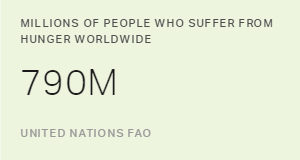
The prevalence of undernourishment** — the FAO’s traditional indicator of the extent of hunger — declined to 7.8% in 2025, marking the third consecutive year of improvement after increases during the COVID-19 pandemic. Hunger affected an estimated 645 million people in 2025, about 14 million fewer than in 2024 and 43 million fewer than in 2022.
Although the prevalence of undernourishment in 2025 was slightly lower than when the SDGs were adopted in 2015, an estimated 50 million more people experienced hunger because of global population growth. On the current trajectory, between 510 million and 520 million people are projected to experience hunger in 2030, leaving the world off track to achieve SDG 2 of ending hunger.
Regionally, Asia and Latin America and the Caribbean continued to make steady progress in reducing hunger. Africa, where one in five people experienced hunger in 2025, showed signs of improvement for the first time since the SDGs were adopted in 2015. The prevalence of undernourishment declined from 20.3% in 2024 to 20.0% in 2025, although population growth meant the number of people experiencing hunger remained essentially unchanged.
While these numbers are projected to continue to decline, more than 500 million may still be facing hunger in 2030, with more than half of those people living in Africa.
Global food insecurity continued to decline, with steady progress in Asia and Latin America and the Caribbean.
The global prevalence of moderate or severe food insecurity declined to 25.8% of the world's population in 2025. This translates into an estimated 2.1 billion people experiencing moderate or severe food insecurity in 2025, nearly 86 million fewer than in 2024 and 135 million fewer than in 2020.
Improvement between 2024 and 2025 was driven by gains in Africa, Asia, and Latin America and the Caribbean. Even so, food insecurity remained widespread, particularly in Africa, where 56.6% of the population experienced moderate or severe food insecurity in 2025, compared with 22.9% in Latin America and the Caribbean, 20.3% in Asia, and 8.7% in Northern America and Europe.
While recent trends point to continued progress, the report cautions that the conflict in the Middle East in 2026, the increase in extreme weather events and reductions in official development assistance could threaten future improvements in global food security.
According to the Global Report on Food Crises 2026, published by the FAO, World Food Programme and Global Network Against Food Crises, acute food insecurity remained widespread in 2025 among populations affected by food crises. Overall, 22.9% of the population analyzed across 47 countries and territories experienced high levels of acute food insecurity, up marginally from 22.7% in 2024 and nearly twice the percentage in 2016.
Dietary diversity remains inadequate for children and women worldwide.
Until 2025, diet quality was not measured as part of the SDG framework. In March 2025, the United Nations Statistical Commission approved Minimum Dietary Diversity for Children (MDD-C) and Women (MDD-W) as new indicators for monitoring progress toward SDG 2.
These indicators assess dietary diversity by counting the number of predefined food groups consumed during the previous 24 hours. Minimum dietary diversity captures diversity and adequacy, two of the four core principles of a healthy diet, along with balance and moderation.
The 2026 SOFI report presents the latest global findings on these two indicators. Globally, only 30.8% of children aged six months to 23 months meet the minimum dietary diversity standard (MDD-C), while 62.7% of women aged 15 to 49 meet the minimum dietary diversity standard (MDD-W).*** This is similar to the estimate reported last year, indicating little change in women's dietary diversity worldwide.
Although the new indicators expand global monitoring of diet quality, major data gaps continue to limit understanding of dietary diversity in many parts of the world. Expanding global monitoring will help provide a more complete picture of diet quality and track progress toward healthier diets.
Billions of people remain unable to afford a healthy diet.
The estimated cost of a healthy diet continued to rise in 2025, reaching 4.28 purchasing power parity (PPP) dollars per person per day, up from 3.44 PPP dollars in 2021 and 2.94 PPP dollars in 2017. Even so, the estimated number of people unable to afford a healthy diet fell from 2.97 billion in 2021 to 2.69 billion in 2025, suggesting that incomes available for food increased faster than food prices, on average.
Despite this improvement, nearly one-third of the world's population remained unable to afford a healthy diet in 2025. Regionally, Africa continued to have the highest prevalence of people facing this, with an estimated 66.6% of the population unable to afford a healthy diet in 2025, more than double the percentage in Asia (28.9%) and Latin America and the Caribbean (25.7%).
Bottom Line
Against the backdrop of worsening humanitarian crises in many parts of the world, the latest SOFI report shows that global hunger and food insecurity continued to decline in 2025, although progress toward SDG 2 remains too slow to achieve Zero Hunger by the 2030 target date.
The report also broadens how global progress is measured by introducing new indicators of diet quality, highlighting the importance of standardized, globally comparable monitoring to better understand long-term trends in food security and nutrition.
Stay up to date with the latest insights by following @Gallup on X and on Instagram.
Julie Ray and Sara Viviani contributed to this article. Sara Viviani is a statistician for the FAO's Food Security and Nutrition Statistics team. Julie Ray is the managing editor for World News at Gallup.
*The data for the FAO's Food Insecurity Experience Scale (FIES) are collected directly from respondents to large national surveys, the Gallup World Poll and other sources.
**The FAO uses different data sources to estimate the different parameters of the model for the prevalence of undernourishment. Figures for the prevalence of undernourishment are nowcasts based on data on food availability and access to food at the country level.
***For women, minimum dietary diversity data are often collected through large standardized surveys, including the Gallup World Poll, as well as national health, nutrition and food security surveys.